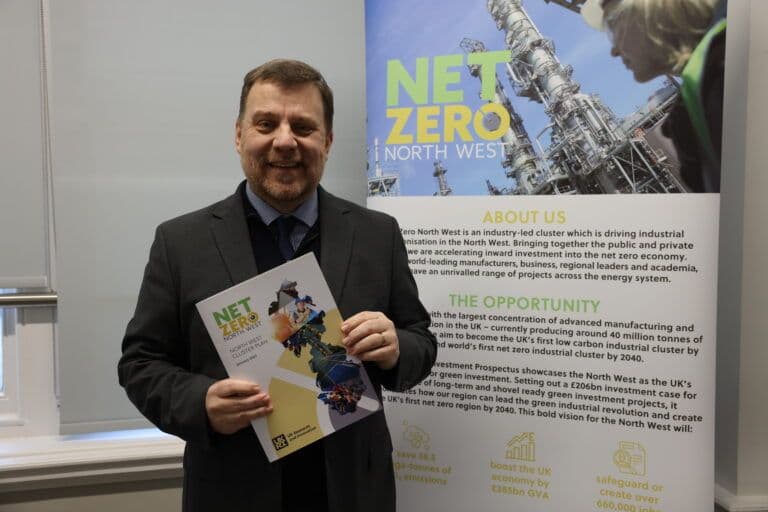
Q&A with Chair of Net Zero North West & Managing Director of Peel NRE, Myles Kitcher

1. Congratulations on your appointment as the new Chair of Net Zero North West. Can you share your vision for the cluster and how you plan to drive sustainable change in the region?
“We’ve already made a great start in the North West, there’s already a lot happening. We need to push on and see more projects and investments delivered, coming off the base of HyNet and a lot of fantastic things businesses are doing across the NW. It’s really about maintaining that momentum; we need to continue to push. There are difficulties in the economy and the markets etc, but there’s a goal there for net zero and we can’t err away from that, we need to continue the pressure on achieving what we want to achieve. I think we’ve made a fantastic start, it’s a testament to a lot of people that we’ve got to where we’ve got to.”
2. As the Managing Director of Peel NRE, what experiences and expertise do you bring to NZNW, and how do you see them contributing to the organisation’s goals?
“Our business is entirely focused on investment and development in low carbon and circular economy-type investment, so I fully understand the opportunities and the challenges around delivering renewable energy schemes, low carbon, and recycling. We are a commercial organisation, we’re there to make money, but we also, in doing that, have to understand the wider impacts and other stakeholders’ involvement in it. I’ve spent 30 years in and around the sector, so I have a lot of personal experience. As a company, we have delivered 300MW of renewable energy, various energy-from-waste schemes, we’ve built a recycling plant… We’ve got a lot of personal experience in delivering projects, especially in the north west, even though we are nation-wide. I have a lot of personal and professional affiliation with the region.”
3. How do you plan to leverage your role as Chair to promote the importance of industrial decarbonisation and create a supportive environment for businesses in the north west Region?
“I think the key to NZNW is the key collaboration across all stakeholders. It’s about assisting businesses and industry to decarbonise whilst maintaining those jobs in the UK, and repurposing infrastructure and skills. It’s all about partnership and working across businesses, with regional and political stakeholders, government – that’s what NZNW is – it’s a facilitator, with a very clear focus of decarbonisation. A business-led organisation with an aim to actually deliver things on the ground, and to encourage investment in the north west. It’s a mixture of two things. 1) Current incumbent business decarbonising in the NW, 2) third parties investing in the NW, and possibly relocating here to build new infrastructure.”
4. NZNW aims to support industry in their decarbonisation efforts. How do you plan to collaborate with key stakeholders and industry leaders to ensure a smooth transition to low-carbon practices whilst maintaining competitiveness and job creation?
“It’s about not seeking to pick winners, we work with all industrial partners across the region, looking at different sectors, assisting and supporting. We have core members but are here to support industrial decarbonisation across the board. It’s about communication, planning, strategic support and creating networks where we can collaborate across sectors. We aim to create a forum where there’s a respectful commerciality. There is competition, but we step away from that. We assist any industrial business in the NW that needs to decarbonise and present a strong economic future for that business and the region.”
“We aren’t a trade organisation; we are a net zero partnership organisation. We must be careful to cover all industries that are facing the same common challenge, albeit looking at different solutions.”
5. Collaboration and partnerships are crucial for addressing the challenges of climate change. How do you envision strengthening partnerships with academic institutions, research organisations, and other relevant stakeholders to promote knowledge sharing and collaborative initiatives in achieving the NW’s decarbonisation goals?
“I think we already, through the work of others, have formed good strategic links with academia, business interest groups, political groups… we need to continue to liaise with the likes of Manchester Metropolitan University, University of Chester, and academic institutes across the region. We need to be totally inclusive, too. It isn’t just about the city regions, it’s about the entire North West region. We need to look at all opportunities that may arise and facilitate a link between organisations so that we’ve got this regionwide footprint and knowledge.”
“There’s a lot of good work being done; we just need to keep doing it in light of the pressures that there will inevitably be around the market etc.”
6. In your opinion, what are the biggest opportunities and obstacles NZNW will face in the pursuit of a net-zero future, and how do you plan to navigate them?
“The biggest opportunities are around CCUS, such as the HyNet project which is key to decarbonising the NW. We’ve still got opportunities around hydrogen, nuclear, etc.”
“The obstacles are that there is a huge shift in the need for infrastructure, there’s huge demands around electrification which is going to put pressure on the current infrastructure. There needs to be investment. We need a new way of working with utilities to ensure that the investment can flow easily into the region and change the way we do business in a way. That will be everything from national policy to national regulation to local policy and localised solutions. There’s a regulatory barrier as well as in investment barrier. We have to be conscious in decarbonisation but also acknowledge the cost-of-living crisis. It needs to be well thought through, measured and timely.”
“So, whilst there are massive opportunities, there are also significant challenges – affordability, investment, regulatory change – that we need to be mindful of.”
7. Carbon capture storage has faced some criticism, despite its many benefits, why do you feel it is an essential, ongoing part of our carbon reduction plan?
“Our transition to a low carbon future is one that will take years to achieve. Carbon capture, whilst not the ideal solution, solves a very immediate issue which is carbon emissions from industry. It’s a short to medium term solution that allows us to rapidly reduce our carbon emissions in the region. We’ve got some big industry, and that can’t just ‘switch off’ overnight. Carbon capture isn’t the only solution but it’s part of it, and we have the opportunity of a relatively low-cost CC solution in the NW that is fundamental to underpinning the decarbonisation of the region. You can’t do it across the entire UK as the opportunity isn’t there.”
The NW seems to champion industrial decarbonisation for the rest of the UK – why is this?
“It’s partly a result of the region coming together from an industrial and political perspective to address the issue. The NW has a lot of natural assets it benefits from (e.g., Irish Sea Gas Fields and carbon storage in the salt caverns etc). It works best, however, if we bring the whole country together. Ideally the NW could provide solutions for the rest of the UK, or even Europe, in that some of the technologies we can develop here, we can export elsewhere.”
“We have a lot of industry with skills, we have decarbonisation of petrochemical industries, there is a lot of innovation coming through that route, similarly to the north east. There’s also lots of people here, with lots of individual actions which serves for the sum of the parts to make the whole.”
8. Are there any other particularly exciting or game changing processes or technologies for reducing carbon in development or close to launch that you excited about and supportive of?
“In the past, we’ve looked at single applications to solve problems – but in reality, there’s a whole host; whether it be nuclear small modular reactors, hydrogen, renewable energy, electrolysis, CCUS – there’s lots to do and we need to do it all. We can’t pick winners. And the beauty of the north west is that we have everything. (See Cluster Plan) We are unique in that we have every ingredient to decarbonise industry. We can nurture the NW, create a skill base to assist delivery. It will be a constant evolution with great things coming in the future, but we shouldn’t forget where we are today and what we need to achieve now.”